
A character that plays along: the hacker cat of Qubix: Glitch City
How we designed the hacker cat in Qubix: Glitch City around the game's events: reactions tied to the board, timed to its sequences and the music.
Bottle Cap Gaming — development notes on the character in Qubix: Glitch City.
Next to the board in Qubix: Glitch City sits a cat in a hoodie, working on a laptop. His reactions follow the board, while a looping idle keeps him moving between rounds. This is how we arrived at that and what it took.
The character follows the board
Three things happen on the Qubix board: hacks rewrite lines, a glitch block appears, and a round can end in a mega cluster with its own finale screen. The cat gives the board’s actions a visible source: a keystroke for each line rewrite, a brief distortion during a glitch, and a celebration during the mega-cluster finale.
That decided his pose. He sits cross-legged right next to the board with the laptop on his knees, so whatever he types visibly lands on the board beside him. His expression barely changes — a focused, slightly grumpy face under the hood — so the body, paws and tail carry the reactions. The headphones give him a reason to nod to the music.
Each reaction needs to remain readable through a sequence of board updates, so we kept only the ones a player can actually see:
| Animation | When it plays | What it shows |
|---|---|---|
idle |
always, under everything else | nods to the beat, eyes run over the code, types unevenly |
hack |
the key-strike phase of each line rewrite | the paw comes down on a key, the laptop jumps with the strike |
glitch |
during the glitch-spawn sequence | a short digital fault through the whole figure |
bigwin |
while the mega-cluster finale is on screen | paws off the keys, a wide swaying celebration |
The animation names describe their roles in the game, giving the art and development work a shared vocabulary.
Timing belongs to the board, not to the clip
Each animation has its own length in the rig, but the game decides how long the moment lasts.
idleis built on the music. It is exactly six beats at the game’s 90 BPM and starts from the same clock as the soundtrack, so the nod stays on the beat.hackis fitted to the strike. The key-strike animation is scaled to fit the strike phase, including the paw’s return. The charge then flashes and travels to the board before the line is rewritten. Played at its own length, each hack in a series would cut off the one before it — you would see the strike but never the paw coming back.glitchis matched to the board. Its playback speed follows the duration of the board’s glitch effect, so the cat glitches with the scene. There is no extra shake applied to him from outside — he already breaks up through his body, head, laptop and tail, and a second shake on top read as a double fault.
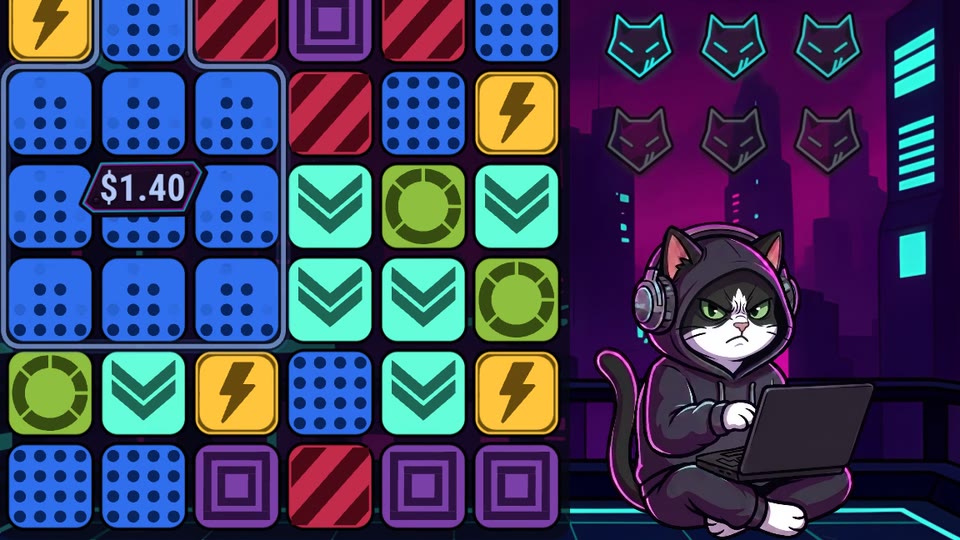
What kind of glitch
A glitch could easily look like the character got scared. We wanted the opposite: the image breaks, not the cat’s nerves. The glitch animation uses stepped keys — the pose jumps from position to position without in-betweens, like a dropped video frame — and stays short. It reads as a signal fault in the same visual language as the board, not as an emotion.
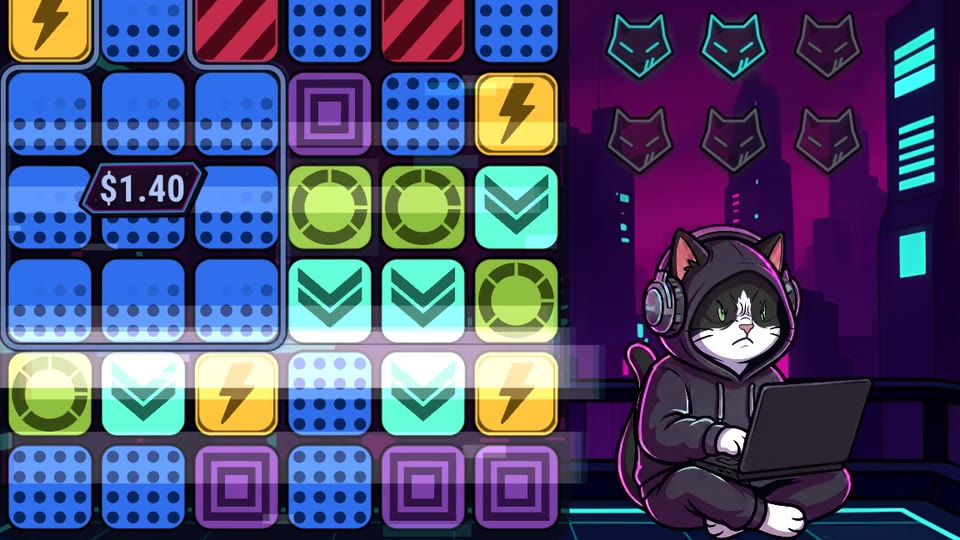
The big win took two attempts
Our first version of the celebration was a jump: the cat bounced on the finale. It looked like a trick the character performed for its own sake, not a response to what was happening on the screen, so we removed it.
What replaced it has two halves, both tied to the finale screen:
- Light from the terminal. While the finale is on screen, a faint neon patch from the laptop falls on the cat’s chest and face, with thin reflections of code lines running down through it. The patch is deliberately narrow — it reaches only where a monitor would actually shine, and not the paws, the headphones or the back of the laptop lid.
- The
bigwinpose. The cat lifts his paws from the keys and sways wider than inidle, in the same musical tempo. He stays on the spot, holds the pose for as long as the finale is shown, and drops it when the finale closes.
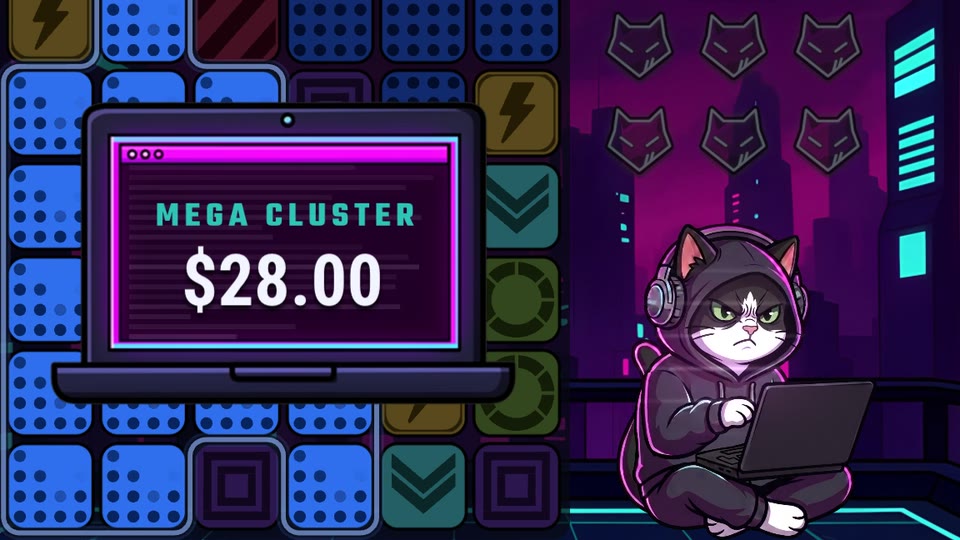
A detail caught in review
Once bigwin was in, we noticed the cat’s eyes kept running over the lines of code while he was celebrating. The celebration plays on top of idle, and idle was still moving the pupils underneath. We added neutral pupil keys to bigwin. We now check which motions from the idle layer should carry through into each reaction, and which the reaction must override.
How the rig was made
The character went through two rigs. The second one split the headphones, cables and laptop screen into separate parts and added bigwin; we reused the existing glitch motion in the revised rig. That rig was built in Riggy, and its step-by-step story is on the Riggy blog: Rigging the Qubix hacker cat.
What we keep from this
- A character in a slot earns its place by making the game’s events easier to read.
- Give animations names that describe their role in the game.
- Let the game set the timing; fit the animation to it rather than the other way round.
- A reaction to the screen reads better than a trick on its own.
Qubix: Glitch City is available on Stake.